
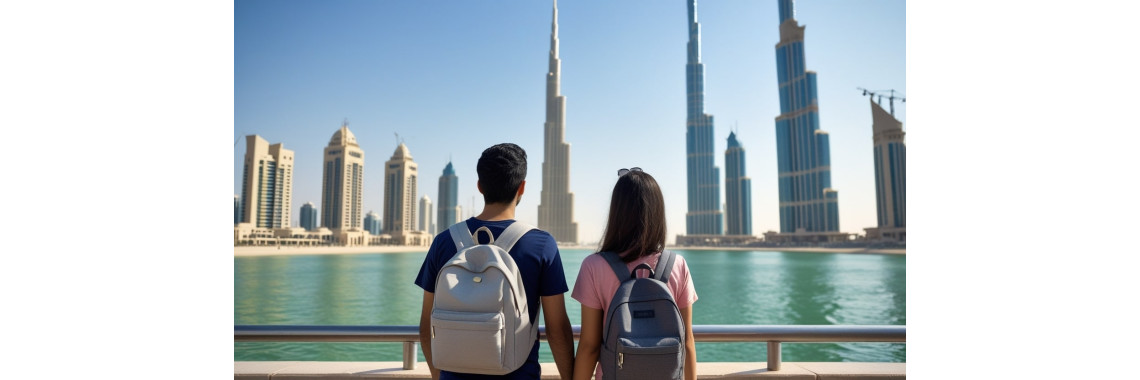
What is a Dubai Dependent Visa?
As mentioned in the introduction, the Dubai Dependent Visa allows you to travel to and reside in the country alongside a family member who lives and works in Dubai.
It is important to know that under UAE immigration laws, the terms “family sponsorship visa” and “dependent visa” both refer to a type of residence visa that enables family members (such as spouses, children, and in some cases parents) to live with expatriates. Holders of residence visas, provided they meet a minimum income requirement and pass medical tests, can sponsor their family members to join them in the country. The visa duration is usually linked to the sponsor’s employment contract.
Recommended Reading: Dubai work visa for Iranians
What are the types of Dubai Dependent Visa?
The type of UAE residence visa depends on the relationship between the dependent and the sponsor in Dubai. This visa is granted to family members of expatriates residing in Dubai. The types of UAE residence visas based on the relationship between the sponsor (resident sponsor) and the dependent are as follows:
- Sponsorship of spouse (spouse and children)
- Sponsorship of parents
- Family sponsorship by spouse
In the article UAE Family Sponsorship Visa Read more about this visa
Who is eligible for a Dubai Dependent Visa?
Now that we know the types of dependent visas in Dubai, we should also understand who qualifies for this visa; residence visas are not issued to sponsor just anyone to bring them to Dubai. Dependent family members of anyone living and working in Dubai can apply for a UAE residence visa. These individuals may include:
- Spouse (husband or wife)
- Unmarried daughters
- Sons under 18 years old
- Parents

Additionally, any expatriate with a residence visa and work permit in the UAE can sponsor domestic helpers such as housemaids, drivers, nannies, etc.
Family members who want to apply for a visa UAE Residency Applicants must comply with the specific conditions set by the UAE Immigration Department. We will fully address these conditions in the following sections.
Dubai Dependent Visa Terms and Conditions
Please note that each visa category has its own specific rules, conditions, and regulations for applying for UAE residency visas in Dubai. A significant change was made by the UAE government in March 2019, where the main sponsor requirement shifted from 'employment' to 'financial status.' In all cases, the sponsor holding a UAE residency visa must declare their financial status to prove they can cover the dependent's expenses without relying on government aid or other financial resources.
The above points include conditions related to the main applicant, but dependents coming to the UAE on a dependent visa must also meet specific requirements. (Remember that all visa applicants over 18 must undergo medical tests, including HIV and tuberculosis screening.)
Among these conditions, the following should be noted:
Conditions for Dependent Son
If the applicant intends to bring his son as a dependent to the UAE, the son must meet the following conditions:
- A dependent son applying for a UAE residency visa must be under 18 years old.
- If the dependent son is over 18, he can only be sponsored if he is under 21 and currently studying.
Conditions for Dependent Daughter
There are specific conditions for the applicant's daughter, which differ from those for a son; the only condition for daughters is as follows:
- A dependent daughter applying for a UAE residency visa must be unmarried.
In the article Dubai Visa Conditions for Single Women Read more about this.
Conditions for a stepchild (adopted child)
If you plan to bring your stepchild or adopted child as a dependent to Dubai, you should also pay attention to the following:
- Any expatriate can sponsor their adopted child under the terms and conditions of the General Directorate of Residency and Foreigners Affairs (GDRFA).
- The sponsor must pay a deposit as a guarantee for each stepchild.
- The sponsor must provide a written 'No Objection' certificate from the biological parent.
Conditions for a newborn
If your child has just been born and you intend to obtain a dependent residence visa for them in Dubai, you need to keep the following in mind:
- The newborn must also receive a residence visa.
- The application for the newborn’s residence visa must be submitted within 120 days from the date of birth.
- A fine of 100 AED per day will be imposed for any delay.
- The newborn will not be allowed to leave the UAE without a valid residence visa.
Conditions for dependent parents
Applicants can also obtain dependent visas for their parents. Obtaining a dependent residence visa for parents involves more complex conditions and important points:
- An expatriate sponsor can support their dependent parents for a period of 1 year (renewable).
- Sponsoring only one parent is not possible; both parents must apply simultaneously.
- If the parents are divorced or one of them has passed away, the relevant official documents must be attached.
- The sponsor must pay a deposit as a guarantee for each dependent parent.
- The sponsor must have a minimum income of 20,000 AED or 19,000 AED along with a two-bedroom accommodation.

Required Documents for Dubai Dependent Visa
One of the most important parts of the process for obtaining a dependent visa for family members is preparing the necessary documents. This step is crucial because any missing or incorrect information can prolong the processing time. Some of the basic documents required for applying for a UAE residence visa (dependent visa) include:
- Completed application form
- Copies of passports of family members
- Passport-sized photos of the applicant's family members
- Medical test certificates
- Copy of employment contract (for husband or wife)
- Income certificate issued by the employer
- Child(ren)'s birth certificate(s) (for children)
- Registered rental contract
How can I apply for a UAE residence visa?
Obtaining a dependent residence visa for family members and dependents generally follows a clear set of steps. Therefore, it is not considered overly complicated or challenging. However, it is important to seek expert assistance along the way to ensure the success of your application; our team is here to support you.
In general, the steps for obtaining a UAE dependent visa can be summarized as follows:
Step 1: Before applying
Make sure you have completed the required medical tests in advance. The UAE expects all visa applicants to have undergone HIV and tuberculosis tests in their home country before applying for a UAE residence visa. If you have not done these tests in your country, you can complete them after arriving in Dubai. Remember, these tests are very important. If the results are positive, the applicant may be sent back to their home country.
Step 2: Document preparation
This is arguably the most important stage. Ensure that you meet all the necessary requirements and have gathered the required documents depending on your relationship with the sponsor in Dubai. Our experts can provide you with comprehensive guidance in this area.
Step 3: Taking photos
Next, you need to take suitable photos to complete your application. The general guidelines for photos required for the UAE residence visa application are as follows:
- The photo must be a recent color photo (not older than three months).
- The photo size should be a digital passport photo.
- The background should be plain white or gray.
- The photo size should be 35mm by 50mm, and the face must be centered in the image.
- At least 80% of your face should be visible in the photo.
- You must face the camera with a natural expression and open eyes.
- Only prescription glasses are allowed; sunglasses or other accessories (except hearing aids) are not permitted.
- You must wear appropriate clothing.
- Religious coverings are allowed provided they do not cover the face.
Step 4: Entry Permit Visa Application
Before applying for a UAE residence visa, the applicant must apply for another visa called the Entry Permit Visa. This visa is also known as the Visitor Visa. The Entry Permit Visa is a temporary visa that grants official entry and residence in the UAE for a specified period. Applying for the Entry Permit Visa is the first step in obtaining a UAE residence visa.
The different types of Entry Permit Visas are:
- Entry Permit – Employment
- Entry Permit – Family Visit
- Entry Permit – Tourism/Transit
- Entry Permit – Medical Treatment
- Entry Permit – Mission
- Entry Permit – Conference Attendance
Step 5: Arrival in Dubai
You have now safely arrived in the UAE and can proceed with the remaining steps to obtain your accompanying residence permit. After arriving in Dubai, you need to take care of the following:
- You must undergo medical tests and wait for the results.
- If the test results are negative, you can apply for a UAE residence visa within 60 days of entering Dubai.
- Inform the relevant embassy or consulate of the test results.
- After completing steps 1 to 4, you can proceed to apply for the UAE residence visa (dependent visa).
Step 6: Applying for the UAE Residence Visa
As mentioned in the previous section, after arriving in Dubai, you must apply for the residence visa within 60 days. You should also have completed the necessary medical tests after arrival. Then, you need to visit the nearest embassy or consulate with all required documents for an interview. (The documents required for the residence visa are the same as those for the entry permit visa.)
Finally, keep in mind that the visa status change is carried out by the General Directorate of Residency and Foreigners Affairs (GDRFA) after all conditions are approved.
Step 7: Validity and Renewal
The validity of your residence visa depends on the sponsor’s visa status in Dubai. Family dependent visas are linked to the sponsor’s visa; if the sponsor’s visa expires or is canceled, the dependent visa also becomes invalid. Here are some important points to know:
- Family members have a 30-day grace period after visa expiration to obtain a new visa.
- If not renewed on time, family members will be considered illegal residents and subject to fines.
Cost of the UAE Residence Visa (Dependent Visa)
Generally, obtaining a UAE residence visa for family members is among the most affordable visas issued by the UAE government. According to the latest changes in 2025, the cost of the UAE residence visa per person is 100 AED annually is.
Processing Time for the UAE Residence Visa
Now that we have all the necessary information about obtaining the UAE residence visa, you might still wonder how long it takes to get the dependent residence visa. Typically, after all approvals are completed, the processing time for the UAE residence visa ranges from 10 days to 3 weeks However, there may be obstacles or delays that could extend the visa processing time.
Final words
Undoubtedly, immigration is easier and offers many benefits for both the applicant and their family when done together with loved ones. If you have migrated to Dubai in any way and now want to bring your family with you, the dependent residence visa can be the best option for you.
In this article, we discussed the family dependent visa in Dubai for 2025, reviewed its conditions, rules, and required documents, and also introduced the cost of obtaining it. You can contact our team’s experts today to start the dependent visa application process and receive comprehensive consultations.


